


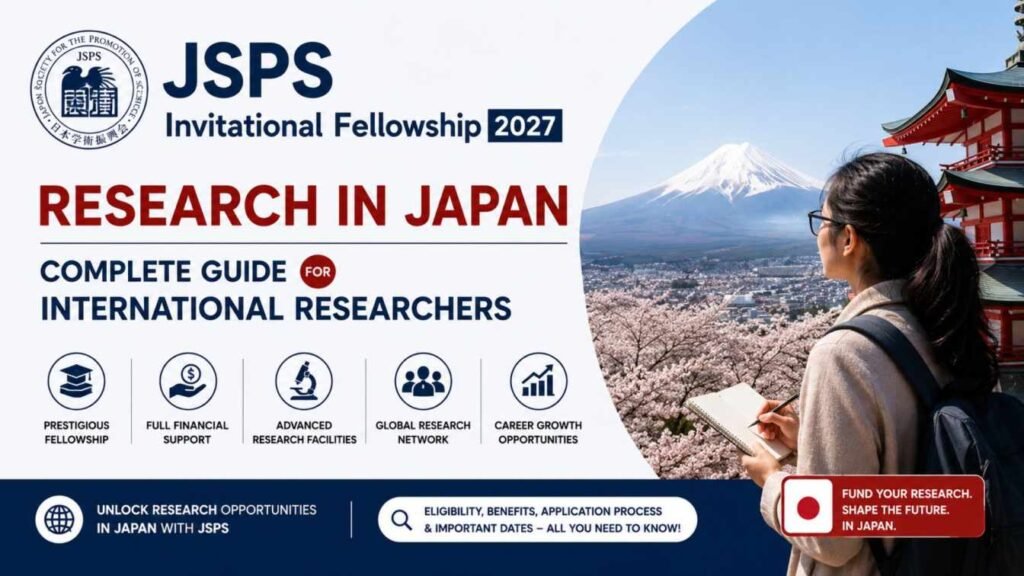
For researchers dreaming of working in world-class laboratories, collaborating with Japanese universities, and expanding their global academic profile, the JSPS Invitational Fellowship 2027 Research in Japan is one of the best fully funded opportunities available today.
Many international fellowships promise funding and global exposure, but often come with hidden limitations — low stipends, excessive teaching responsibilities, or complicated application systems. The JSPS Invitational Fellowship 2027 Research in Japan stands out because it is built purely for academic collaboration and advanced research.
Whether you are from India, Southeast Asia, Europe, or any other eligible country, this fellowship opens the door to Japan’s highly respected research ecosystem.
Official Website:
JSPS Invitational Fellowship Official Page
What is JSPS?
The Japan Society for the Promotion of Science, commonly known as Japan Society for the Promotion of Science (JSPS), is Japan’s leading academic funding organization.
Established in 1958, JSPS has played a major role in promoting international academic exchange and collaborative research between Japan and researchers worldwide.
The JSPS International Fellowships for Research in Japan 2026 and upcoming 2027 cycles are highly respected among universities and research institutions globally.
The fellowship allows foreign researchers to:
- Conduct collaborative research in Japan
- Participate in seminars and academic exchanges
- Deliver lectures at Japanese universities
- Build long-term international research partnerships
- Access advanced Japanese laboratories and research facilities
Learn more about Golden Week in Japan in 2026 and its importance in Japanese culture and traditions.
The program supports all academic disciplines including:
- Engineering
- Medical Sciences
- Artificial Intelligence
- Natural Sciences
- Humanities
- Social Sciences
- Environmental Studies
- Robotics
- Language & Cultural Studies
Why the JSPS Invitational Fellowship 2027 Research in Japan is So Popular
The biggest reason researchers apply for the JSPS Invitational Fellowship 2027 Research in Japan is the combination of funding, flexibility, and academic prestige.
Unlike many fellowships, JSPS allows researchers to focus entirely on research without heavy teaching obligations.
The program also provides generous financial support, including:
| Benefits | Amount |
| Monthly stipend (Long-Term) | ¥387,600 per month |
| Daily allowance (Short-Term) | ¥18,000 per day |
| Round-trip airfare | Fully funded |
| Overseas travel insurance | Covered |
| Research support allowance | Up to ¥150,000 |
The JSPS Fellowship amount is considered extremely competitive compared to many global research fellowships.
For Indian researchers, the monthly stipend often converts to approximately ₹2.2–2.5 lakh per month depending on currency exchange rates.
If you are preparing for Japanese exams, check these useful JLPT N5 and N4 Online Resources for better preparation.
Fellowship Categories
The Japan Fellowship Program 2026 and 2027 cycle mainly offer two formats.
1. Long-Term Fellowship
The Long-Term category is ideal for researchers seeking deep collaboration and extended research work.
Duration
2 to 10 months
Suitable For
- Associate Professors
- Assistant Professors
- Mid-career researchers
- Researchers with over 6 years since PhD completion
Purpose
- Long collaborative projects
- Joint publications
- Experimental research
- Institutional partnerships
The JSPS Postdoctoral Fellowships for Research in Japan are often compared with this category because both focus on intensive academic collaboration.
2. Short-Term Fellowship
The JSPS Short-term Fellowship for foreign researchers is designed for focused academic visits.
Duration
14 to 60 days
Suitable For
- Senior researchers
- Professors
- Visiting scholars
- Academic experts
Activities Include
- Lectures
- Workshops
- Academic seminars
- Research discussions
- Short collaborative studies
This category is highly useful for researchers who cannot stay in Japan for several months but still want international exposure.
Students planning to work in Japan can also read about the JLPT N2 Work Visa requirements and opportunities.
Eligibility Criteria for Indian Researchers
The JSPS Invitational Fellowship 2027 Research in Japan is open to applicants from countries maintaining diplomatic relations with Japan, including India.
You may qualify if:
- You are a full-time researcher at a university or research institution
- You hold a position similar to:
- Professor
- Associate Professor
- Assistant Professor
- Professor Emeritus
- OR you completed your PhD more than 6 years ago with continuous research experience
Researchers from institutions like:
- Indian Institute of Technology
- Indian Institute of Science
- University of Delhi
- CSIR laboratories
- IISERs
- Central universities
are commonly eligible.
Fields Accepted Under the Fellowship
One of the strongest aspects of the JSPS International Fellowships for Research in Japan 2026 is that the fellowship is open to all research disciplines.
Accepted fields include:
- Artificial Intelligence
- Biotechnology
- Mechanical Engineering
- Quantum Physics
- Data Science
- Environmental Science
- Japanese Studies
- Economics
- Literature
- Public Policy
- Medical Sciences
- Sociology
This wide eligibility makes the JSPS Fellowship 2026 27 attractive to researchers across different academic backgrounds.
Explore the latest NAT Exam Dates in Japan 2026 to stay updated with upcoming exam schedules.
How to Apply for JSPS Invitational Fellowship 2027 Research in Japan
Most applicants fail because they misunderstand the process.
The application is not submitted directly by the overseas researcher.
Step 1 – Find a Japanese Host Researcher
This is the most important part.
You must connect with a professor or researcher at a Japanese institution willing to host you.
Search using:
- Google Scholar
- ResearchGate
- Japanese university websites
- Academic conferences
- Published research papers
When contacting professors:
- Be professional
- Explain your research clearly
- Mention why collaboration matters
- Share publications or research profiles
Finding the right host may take several months.
You can also understand the complete MEXT Scholarship 2027 Application Process for studying in Japan.
Step 2 – Collaborate on a Research Proposal
The proposal is prepared jointly between you and the Japanese host researcher.
The proposal should explain:
- Research goals
- Timeline
- Expected outcomes
- Importance of collaboration
- Methodology
- Publication plans
A strong proposal significantly improves selection chances.
Step 3 – Submission by Japanese Host Institution
The Japanese host researcher submits the application through:
- Their institution
- Institutional head approval
- JSPS Electronic Application System
This is why communication with your host is critical.
Important Application Forms
The fellowship generally requires:
| Form | Purpose |
| L-1 / S-1 | Basic application details |
| L-2 / S-2 | Research proposal |
| L-3 / S-3 | CV of overseas researcher |
Always check the latest forms on the official JSPS portal.
Official Link:
JSPS Application Information
JSPS Fellowship Results and Selection Process
The JSPS Fellowship results are based entirely on academic merit and collaboration quality.
Selection panels evaluate:
- Research proposal quality
- Academic achievements
- Publications
- Host researcher credibility
- Collaboration potential
- Feasibility of research timeline
The process involves expert reviewers and academic panels.
Because of the competitive nature of the program, applicants should begin preparation early.
Discover the Best Universities in Japan for Indian Students before applying for higher education abroad.
Why Indian Researchers Should Consider This Fellowship
India and Japan have growing academic and scientific partnerships.
Researchers participating in the JSPS Invitational Fellowship 2027 Research in Japan gain:
- International exposure
- Access to advanced labs
- Strong academic networking
- Future grant opportunities
- Joint publications
- Better institutional recognition
For many Indian researchers, a successful JSPS fellowship becomes a major career milestone.
It also strengthens future opportunities in:
- International collaborations
- Academic promotions
- Global conference invitations
- Cross-country research funding
Long-Term vs Short-Term Fellowship Comparison
| Features | Long-Term | Short-Term |
| Duration | 2–10 months | 14–60 days |
| Stipend | ¥387,600/month | ¥18,000/day |
| Focus | Deep research collaboration | Academic exchange |
| Application Rounds | Once yearly | Twice yearly |
| Suitable For | Mid-career researchers | Senior researchers |
Before moving abroad, read about the Japan Student Visa Work Hours Limit 2026 for international students.
Tips to Improve Your Chances
Start preparing for the JSPS Invitational Fellowship 2027 Research in Japan as early as possible, especially when searching for a Japanese host researcher.
1. Start Early
Finding a Japanese host can take time.
2. Build a Strong Academic Profile
Publications and research experience matter greatly.
3. Write a Practical Proposal
Avoid vague or unrealistic ideas.
4. Communicate Professionally
Japanese academic culture values professionalism and clarity.
5. Learn Basic Japanese
Even basic language knowledge creates a positive impression.
Researchers preparing for Japan often choose language institutes before applying.
Common Mistakes Applicants Make
Many applicants fail due to avoidable errors.
Common Problems Include:
- Weak host researcher connection
- Generic proposal writing
- Missing deadlines
- Poor communication
- Lack of publication history
- Unrealistic research plans
Careful preparation can significantly improve your chances.
Want to know about earning opportunities? Check the Average Salary in Japan across different industries and job roles.
Deadline Information
The JSPS Fellowship 2026 27 schedule typically follows:
Long-Term Fellowship
- Opens once annually
Short-Term Fellowship
- Usually opens twice yearly
Your Japanese host institution may also have internal deadlines earlier than JSPS deadlines.
Always verify timelines directly from the official website.
Official Schedule:
JSPS Official Fellowship Schedule
FAQs About JSPS Invitational Fellowship 2027 Research in Japan
1. What is the JSPS Invitational Fellowship 2027 Research in Japan?
The JSPS Invitational Fellowship 2027 Research in Japan is a fully funded international research program offered by the Japan Society for the Promotion of Science. It allows overseas researchers to collaborate with Japanese universities and research institutions. The fellowship supports research, lectures, seminars, and academic exchange activities. Researchers from India and many other countries are eligible to apply through a Japanese host institution.
2. Who can apply for the JSPS Invitational Fellowship 2027 Research in Japan?
Researchers working full-time at universities or recognized research institutions can apply. Applicants are usually professors, associate professors, assistant professors, or researchers with more than 6 years of experience after completing a PhD. Indian researchers from IITs, IISERs, central universities, and research labs commonly qualify. The program welcomes applicants from all academic disciplines.
3. What is the duration of the JSPS Invitational Fellowship 2027 Research in Japan?
The fellowship has two major categories. The Long-Term Fellowship lasts between 2 to 10 months and is suitable for deep collaborative research projects. The Short-Term Fellowship runs from 14 to 60 days and focuses on academic exchange, lectures, and short collaborative work. Applicants can choose the category based on their research goals and availability.
4. What benefits are provided under the JSPS Invitational Fellowship 2027 Research in Japan?
Selected fellows receive round-trip airfare, overseas travel insurance, research support, and generous financial allowances. Long-term fellows receive approximately ¥387,600 per month, while short-term fellows receive around ¥18,000 per day. Additional research support allowances may also be provided through the host institution. The fellowship is considered one of the most financially rewarding international research programs.
5. How do I find a Japanese host researcher for the JSPS Invitational Fellowship 2027 Research in Japan?
Applicants should search for Japanese professors whose research matches their own field of study. Platforms like Google Scholar, ResearchGate, and Japanese university websites are helpful for finding potential hosts. Sending a professional and personalized email explaining your research interest is important. Building a strong academic connection with the host researcher significantly improves selection chances.
6. Can Indian researchers apply for the JSPS Invitational Fellowship 2027 Research in Japan?
Yes, Indian researchers are fully eligible to apply for the fellowship because India maintains strong academic and diplomatic relations with Japan. Faculty members and researchers from institutions such as IITs, IISc, CSIR labs, and central universities frequently apply. The fellowship is highly valuable for Indian scholars seeking international exposure and collaborative research opportunities in Japan.
7. Is IELTS or Japanese language proficiency required for the JSPS Invitational Fellowship 2027 Research in Japan?
No, IELTS or Japanese language certificates are generally not mandatory for this fellowship. Most research work is conducted in English, especially in scientific and technical fields. However, learning basic Japanese can help researchers communicate better with local faculty, students, and institutions. Understanding Japanese culture and etiquette is also beneficial during the fellowship period.
8. How competitive is the JSPS Invitational Fellowship 2027 Research in Japan?
The fellowship is highly competitive because researchers from around the world apply every year. Selection depends on research quality, academic achievements, publications, and the strength of collaboration with the Japanese host researcher. A clear and practical research proposal can greatly improve your chances. Applicants should begin preparing several months in advance.
9. How are the JSPS Fellowship results announced?
The JSPS Fellowship results are usually announced after the evaluation process is completed by expert review panels. Applicants are informed through their Japanese host institution. The timeline may vary depending on the fellowship category and application cycle. Researchers should regularly check updates on the official JSPS website and stay in touch with their host institution.
10. Where can I apply for the JSPS Invitational Fellowship 2027 Research in Japan?
Applicants can review guidelines, deadlines, forms, and official updates on the official JSPS website. Since applications must be submitted through a Japanese host researcher, overseas researchers cannot apply independently. All official information is available here:
JSPS Official Fellowship Website
Final Thoughts
The JSPS Invitational Fellowship 2027 Research in Japan is one of the best opportunities available for international researchers seeking world-class academic collaboration.
With generous funding, global recognition, and access to Japan’s advanced research ecosystem, the fellowship offers far more than financial support. It opens the door to long-term international partnerships and career growth.
Whether you are an engineering researcher, scientist, professor, or scholar in the humanities, the JSPS International Fellowships for Research in Japan 2026 and upcoming 2027 cycle deserve serious consideration.
If you are planning to apply, begin preparing early, strengthen your research profile, and focus on building meaningful connections with Japanese researchers.
Ganbatte! (Good luck!)